CV Suite
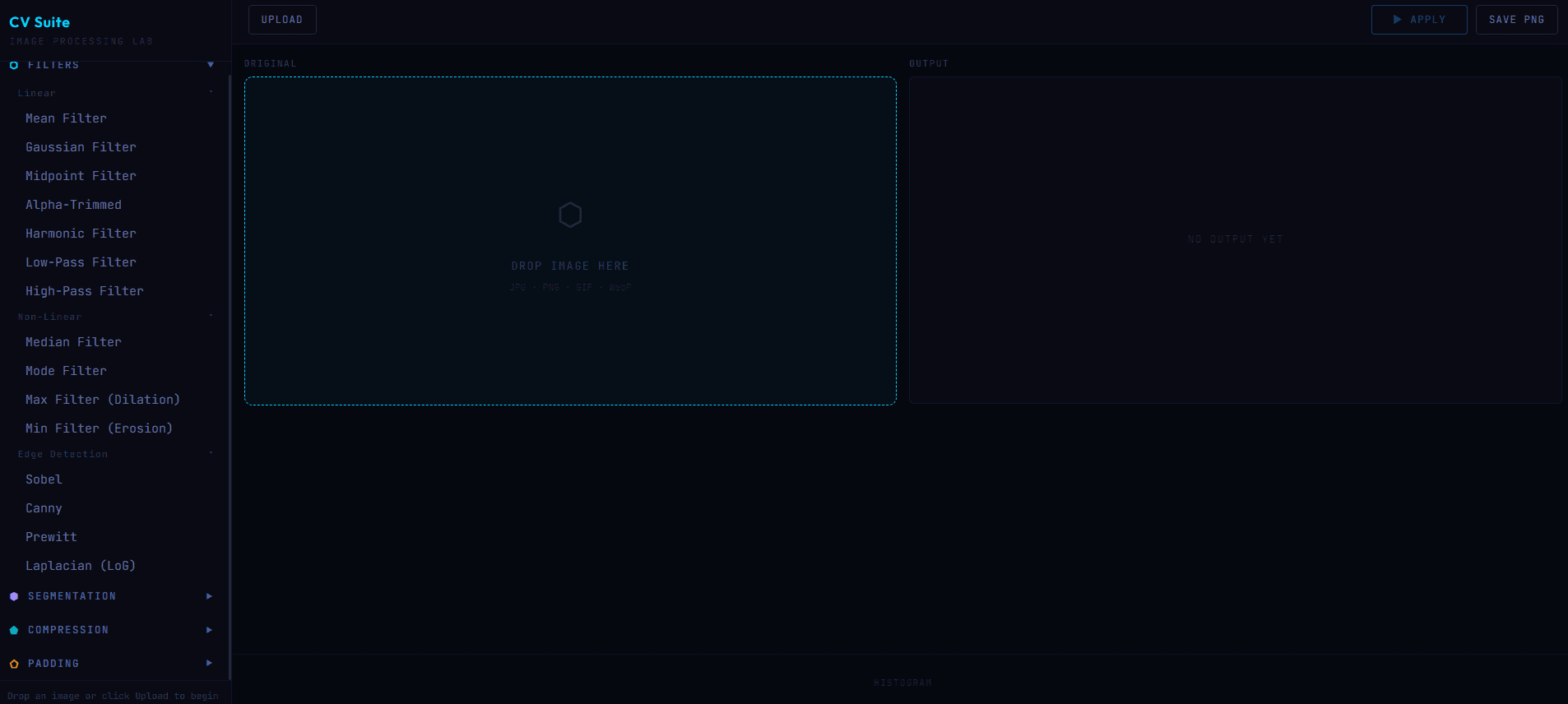
High-performance image processing lab providing a browser-based environment for classical Computer Vision algorithms. Implemented complex linear/non-linear filters, edge detection (Canny, Sobel), segmentation (Otsu, K-Means), and compression analysis (Huffman, LZW) with real-time millisecond execution tracking.
Timeline
2024
Role
Lead Developer
Status
In-progressTechnology Stack
Key Challenges
- Implementing the Canny edge detector from scratch required multiple passes (Gaussian blur, gradient calculation, non-maximum suppression, and hysteresis thresholding) while maintaining browser performance.
- Optimizing K-Means clustering for large images to avoid blocking the main thread during the iterative centoid calculation.
Key Learnings
- Pixel-level manipulation in JavaScript requires a deep understanding of TypedArrays and the Canvas API for performance.
- Real-time visualization of algorithm intermediate steps (like gradient magnitude vs. direction) is a powerful educational tool.
The Problem
Learning classical computer vision algorithms often requires complex local setups or heavy Python libraries like OpenCV. For many students and engineers, there is no high-performance, interactive playground to experiment with these algorithms directly in the browser and see real-time performance metrics.
Technical Decisions
Vanilla JavaScript Engine: To demonstrate deep algorithm knowledge, I implemented every image processing filter (Mean, Gaussian, Median, Sobel, Canny) in pure Vanilla JavaScript rather than using libraries. This ensures complete control over pixel-level manipulation and memory usage.
High-Performance Computation: Heavy pixel-by-pixel calculations are optimized to run in the browser. I implemented real-time execution tracking that measures the performance of each operation in milliseconds, providing a laboratory environment for analyzing algorithm complexity.
Comprehensive Feature Set:
- Filters: Both linear (Gaussian, Mean) and non-linear (Median, Mode, Alpha-Trimmed) implementations.
- Edge Detection: High-accuracy kernels for Sobel, Prewitt, and Laplacian operators.
- Segmentation: Advanced algorithms including Otsu Thresholding, K-Means clustering, and Watershed transforms.
- Compression: Visual analysis of RLE, Huffman, and LZW compression efficiency.
Modern UI with Next.js 15: The laboratory environment uses a clean, responsive sidebar-based UI built with Next.js 15 and Tailwind CSS, allowing for real-time parameter adjustment and live histogram visualization.
The Outcome
A high-performance web application that serves as a comprehensive laboratory for computer vision education. It allows users to upload images and instantly apply complex mathematical transforms with sub-second execution times, all without leaving the browser.